


Hotel Internet Logs Only Retained for 7 Days? Risk a Fine of 100,000 RMB! Interpretation of Full-Optical Network Log Storage Solution
2026-08-14 14:58:14
17
Hotel Internet Logs Only Retained for 7 Days? Risk a Fine of 100,000 RMB! Interpretation of Full-Optical Network Log Storage Solution
Is Wi-Fi access as simple as scanning a posted password at the front desk? If you still take such shortcuts, you may face official public security warnings, hefty fines, or even business suspension for rectification next time.
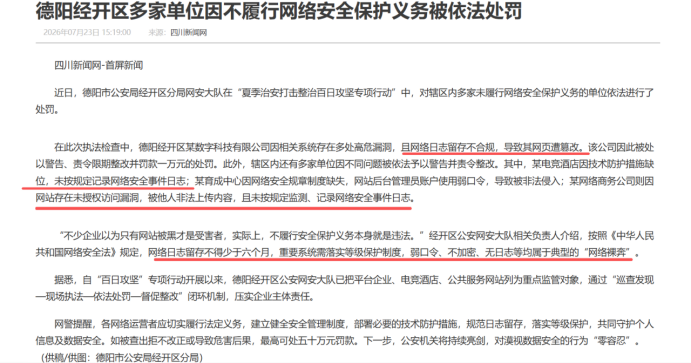
Since 2025, public security authorities in Xinjiang, Shandong, Jiangsu and many other regions have launched intensive special cybersecurity inspections for public internet access venues, issuing administrative penalties to dozens of hotels and homestays. In July 2026, an e-sports hotel in Deyang was given a warning, ordered to rectify within a time limit and fined 10,000 RMB due to inadequate technical protection measures and failure to record cybersecurity incident logs as required. Multiple hotels in Xichang (Sichuan), Yijun (Shaanxi) and other locations also received legal warnings for failing to implement real-name registration for wireless network access.
Regulatory enforcement has become fully tangible. The root cause for the majority of penalized hotels boils down to one single problem: non-compliant retention of internet access logs.
I. What Exactly Do Laws and Regulations Stipulate?
For network operators such as hotels providing public Wi-Fi services, legal liabilities are defined under two core national regulations:
The newly revised Cybersecurity Law of the People’s Republic of China, which came into force on January 1, 2026;
Ministry of Public Security Decree No. 151, the Provisions on the Supervision and Inspection of Internet Security by Public Security Organs.
Jointly, the two regulations impose three statutory obligations on operators:
Real-Name Authentication: Operators must verify users’ valid identity information (mobile phone number or ID number), and anonymous network access is prohibited.
Log Retention: Complete records of users’ online activities must be preserved, covering core fields including real-name information, login/logout timestamps, IP addresses, MAC addresses, visited URLs, traffic consumption and more. Logs shall be retained for no less than 180 days (6 months) by law, with built-in anti-tampering mechanisms, exportable files and full audit trails.
Security Protection: Technical safeguards must be deployed to defend against viruses, cyberattacks and intrusions, equipped with basic capabilities such as malicious URL filtering, intrusion detection and abnormal traffic identification.
The revised Cybersecurity Law has raised the maximum corporate fine from several hundred thousand RMB to 10 million RMB, with a maximum penalty of 1 million RMB imposed on directly responsible individuals. The flexible clause granting a warning for first-time violations has also been abolished.
II. Three Critical Pitfalls in Hotel Log Storage
Most hotels do not violate regulations intentionally; they simply remain unaware of flaws in their log archiving methods. Three common pitfalls are as follows:
Pitfall 1: Log Retention Period Limited to Only 7 or 30 Days
Classified Protection 2.0 and MPS Decree No. 151 explicitly mandate a minimum 180-day log retention window. Nevertheless, most hotel routers overwrite logs automatically after just 7 or 30 days due to limited onboard storage. Many operators mistake "having log storage available" for "being fully compliant", which is quickly exposed during official inspections.
Pitfall 2: Incomplete Log Fields
Compliant logs must include the full network 5-tuple (source IP, destination IP, source port, destination port, timestamp), user identity (mobile phone/ID number), and access behaviors (URLs, traffic volume, etc.). Most consumer and entry-level routers merely record Wi-Fi connection records without tracking visited websites. Incomplete log fields are legally equivalent to no logs at all, leaving the hotel fully liable when security incidents occur with no traceability available.
Pitfall 3: Tamperable or Deletable Log Records
Regulations require logs to be anti-tampering, exportable and auditable. In many hotels, logs are stored on ordinary routers or switches where administrators can arbitrarily modify or delete records. Manipulating or erasing logs to evade accountability during security incidents constitutes evidence destruction, leading to far more severe legal consequences.
III. Three Fatal Flaws of Traditional Log Storage Solutions
Even when hotels recognize the importance of log retention, legacy architectures can hardly meet compliance standards:
Flaw 1: Dispersed Devices Lead to Fragmented Logs
Traditional hotel networks adopt siloed independent construction: separate hardware for guest Wi-Fi, office LAN and surveillance systems. Logs are scattered across routers, switches, firewalls and AC controllers. When regulators require one-click export of standardized compliance reports, IT staff have to extract data from 4–5 devices and manually consolidate files, a time-consuming process prone to human error.
Flaw 2: Insufficient Storage Capacity Triggers Automatic Log Overwriting
Built-in storage on conventional network devices is extremely limited, ranging from hundreds of megabytes to a few gigabytes for enterprise-grade routers. A 200-room hotel generates several gigabytes of log data daily, exhausting local storage within days and triggering automatic rollover of historical logs. It is technically impossible for legacy hardware to fulfill the 180-day retention requirement set by Classified Protection regulations.
Flaw 3: High Risks of Log Loss and Tampering
Logs stored on local hard drives or device onboard storage lack encryption and anti-tampering safeguards. Equipment crashes, hard disk failures or accidental human operations can result in permanent data loss. Without intact audit trails for official inspections or security incident investigations, hotels have no choice but to accept penalties.
IV. AINOPOL Full-Optical Network Log Storage Solution: Out-of-the-Box Compliance
AINOPOL embeds comprehensive log storage capabilities directly into the full-optical network infrastructure, eliminating the need for third-party log servers and enabling instant compliance with MPS Decree No. 151 upon deployment.
Capability 1: Automatic Full-Volume Log Collection
The system automatically aggregates complete datasets including user internet access logs, device operation logs, security event logs, administrator operation records and screen casting behavior logs. Captured parameters cover source IP, destination IP, source port, destination port, access timestamp, user MAC address, verified mobile/ID number, room number and other detailed markers, fully satisfying public security traceability requirements.
Capability 2: Local Encrypted Storage with Default 180-Day Retention
Logs are stored locally on the hotel premises with encrypted multi-replica protection, locked against unauthorized modification or deletion. The default retention cycle is 180 days, with scalable expansion options for longer archiving periods. All log data stays within the hotel’s internal LAN to eliminate data leakage risks associated with cloud uploads.
Capability 3: Multi-Dimensional High-Speed Query
Supports combined filtering across time frame, source/destination IP, user identity, application type, room number and other dimensions, with query response latency under 1 second. Security incidents can be pinpointed rapidly without manual review of massive raw log datasets.
Capability 4: One-Click Export of Compliance Reports
Standard audit documents formatted per public security authority specifications can be generated and exported in one click on a daily, weekly or monthly basis, removing the burden of manual log sorting for regulatory audits.
Capability 5: Automatic Alerts for Abnormal Behaviors
Built-in anomaly detection models trigger real-time notifications for suspicious activities such as brute-force cracking, unauthorized access, frequent repetitive browsing and non-compliant screen casting, allowing administrators to intervene promptly.
V. Full-Optical Architecture Streamlines Compliant Log Retention
The inherent structural advantages of the full-optical network make standardized log archiving straightforward:
Legacy networks adopt a three-tier core-aggregation-access architecture, dispersing logs across dozens of individual devices. The AINOPOL full-optical POL network features a streamlined two-layer core-access flat framework, cutting the total number of active network devices by 80%.
All traffic — guest Wi-Fi, office LAN and IoT device data — converges at the central OLT and gateway for unified processing. Log collection endpoints are consolidated from dozens of scattered devices down to a single core node, guaranteeing complete full-volume log collection and centralized storage with zero omissions.
More importantly, the full-optical architecture natively supports logical isolation of three independent networks: guest network, office network and IoT network. Logs from each segment are automatically partitioned for isolated storage without cross-interference, enabling regulators to extract segmented audit records clearly and efficiently during site visits.
The Ministry of Public Security mandates a minimum 6-month retention period for internet behavior audit logs. The revised Cybersecurity Law imposes a maximum corporate fine of 10 million RMB and a 1 million RMB penalty for individual liable parties, alongside potential business suspension orders.
Compliant log retention is no longer an optional add-on but a mandatory compliance task. The AINOPOL full-optical network log storage solution integrates regulatory capabilities deep into the optical communication foundation, delivering out-of-the-box compliance and stress-free regulatory inspections.
FAQ
Q: How long must hotels retain internet access logs by law?
A: Per the Cybersecurity Law and MPS Decree No. 151, hotels offering public Wi-Fi must preserve user access logs for no less than 180 days (6 months), with enforced anti-tampering protection, export functionality and full auditability.
Q: Are the built-in log functions on regular hotel routers sufficient?
A: No. Most routers only record basic connection events and cannot capture the complete 5-tuple data, user identity credentials and detailed browsing activities. Their limited onboard storage also cannot sustain the 180-day mandatory retention cycle.
Q: What is the worst-case consequence of failing to implement compliant log storage?
A: In the event of cybersecurity incidents, the hotel bears full legal liability due to untraceable network behaviors. Additionally, under the revised Cybersecurity Law, the enterprise may face a maximum fine of 10 million RMB, responsible individuals up to 1 million RMB in penalties, and compulsory suspension of business for rectification.


