Not‑So‑“Dumb” Terminals: How All‑Optical Networks Prevent Cameras, Access‑Control Units and Digital Signage from Becoming Security Backdoors
2026-08-28 13:50:26
6
Not‑So‑“Dumb” Terminals: How All‑Optical Networks Prevent Cameras, Access‑Control Units and Digital Signage from Becoming Security Backdoors

Cameras are capturing footage, access‑control systems are performing identity verification, and digital‑signage screens are playing content. On the surface, they appear to be ordinary campus devices.
From a cybersecurity perspective, however, these endpoints are far from “dumb”.
They stay online round‑the‑clock, exist in massive quantities, and usually lack the robust security protections found on PCs. Should any device contain vulnerabilities, weak passwords or suffer unauthorised access, it can serve as an entry point for threat actors to breach corporate networks.
As more cameras, access‑control hardware, public‑address systems and digital‑signage panels join enterprise networks, the traditional security mindset of “protect only PCs and servers” is no longer sufficient.
Truly effective campus cybersecurity must secure every potential exploit‑prone entry point.
I. Why Cameras, Access‑Control and Digital‑Signage Easily Become Security Backdoors
Simple‑looking devices with persistent network connectivity
IT teams routinely manage account permissions, system patches and antivirus protection for employee‑operated PCs.
By contrast, cameras, access‑control units and digital‑signage screens are frequently overlooked.
A camera may remain online 24/7; access‑control terminals run continuous identity authentication every day; digital‑signage panels maintain permanent network connections.
Though they lack complex interactive interfaces, they share one key trait:
once connected to the network, they become potential targets for compromise.
Compounding the risk, campuses typically deploy large fleets of such hardware. Greater device volumes raise the difficulty of per‑device administration and troubleshooting.
Real danger: lateral movement after a single device is compromised
Imagine a digital‑signage panel gets hacked.
If its network segment is fully isolated from office and server networks, risks remain confined to that limited zone.
If all devices operate within a freely routable network environment, attackers can scan for further targets and seek new breach vectors.
Enterprises therefore need to address not only:
“How do we stop terminals from being hacked?”
but also:
“What resources can a compromised terminal reach?”
This embodies the critical security principles of least‑privilege access and network isolation for campus infrastructures.
Cameras have no legitimate reason to reach employee workstations; digital‑signage should not contact core servers; access‑control hardware must not possess network permissions beyond operational requirements.
Giving each terminal access only to resources it legitimately needs is how organisations contain risk.
II. How All‑Optical Networks Transform “Dumb Terminals” from Entry Vectors into Secure Nodes
Securing dumb terminals cannot rely solely on post‑incident remediation.
A more effective approach enforces identity validation, permission sets and access scopes from the moment a device connects to the network.
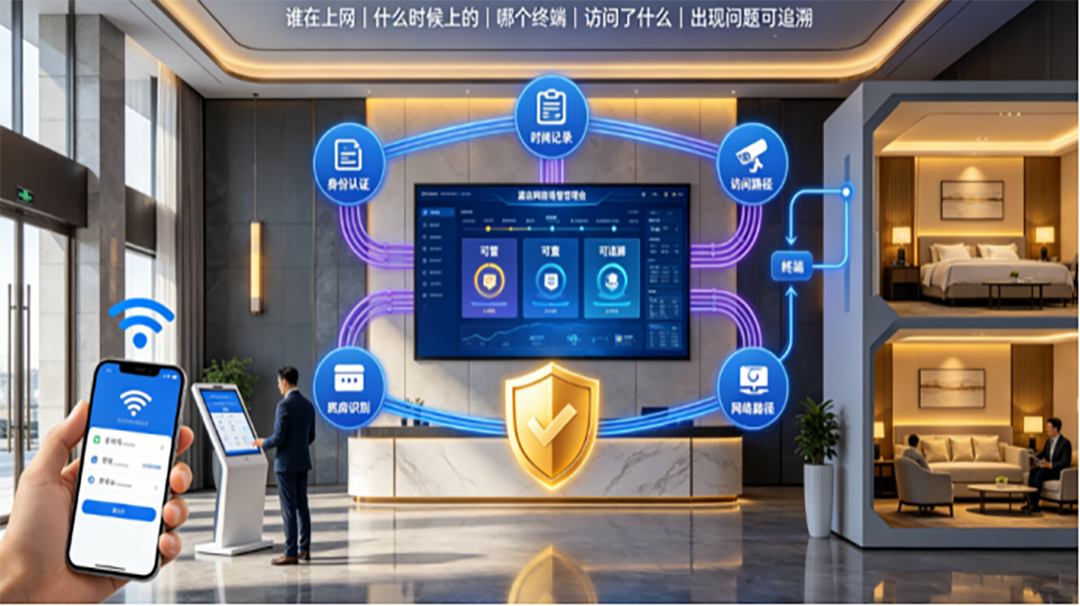
AINOPOL enterprise campus all‑optical solutions leverage endpoint admission control, service isolation and link‑level encryption to establish security perimeters for cameras, access‑control hardware, digital‑signage and similar endpoints at the underlying network layer.
Authenticate first, then grant access — no plug‑and‑play access
For fixed campus endpoints, identity verification can be implemented via 802.1X, MAC‑address binding, ONU serial‑number whitelisting and physical port binding.
Dumb endpoints such as access‑control hardware and SIP phones can be bound to dedicated ONU physical ports.
Instead of:
“Grant network access to any connected device.”
the network enforces:
“Validate device identity before permitting network join.”
Unauthorised device swaps or rogue endpoints cannot inherit the network privileges of legitimate hardware.
This access gateway is critical for large deployments of cameras, access‑control units and IoT devices.
Service isolation: separate traffic for cameras, access‑control and office PCs
Following successful authentication, the scope of reachable resources must be restricted.
AINOPOL utilises PON logical slicing to segregate office, security‑surveillance and digital‑signage workloads.
For example:
Office endpoints reside on the office network; cameras and access‑control hardware sit on the security‑surveillance network; digital‑signage panels occupy an independent signage network.
While all services share the same fibre infrastructure, they do not freely intercommunicate. Cross‑network access is enabled only through purpose‑built policy configurations.
Even if a camera or digital‑signage device becomes compromised, threat actors cannot readily pivot into the office network.
The all‑optical infrastructure handles transport; service isolation draws security boundaries.
Proper isolation permits digital‑signage panels to receive content exclusively from management platforms while limiting their ability to initiate outbound connections toward internal systems.
Even when endpoint‑level vulnerabilities exist, the blast radius is contained within its dedicated service domain.
Additionally, PON links support AES‑128 encryption for in‑transit traffic, further hardening data transmission over fibre.
More “dumb terminals” will populate future enterprise campuses.
Cameras, access‑control hardware and digital‑signage are just the beginning; additional AI endpoints, sensors and smart devices will keep joining networks.
Deploying discrete security tools for every new device type will only overcomplicate campus infrastructures.
Greater emphasis should therefore be placed on foundational network security capabilities:
enforced authentication for endpoint onboarding, service‑level segmentation, protection for data‑in‑transit, and defined boundaries for cross‑network communication.
Built on all‑optical infrastructure, AINOPOL combines endpoint admission control, PON‑based service isolation and link encryption. This allows diverse endpoints stable connectivity without exposing one another simply because they share the same physical network.
Ultimately, dumb terminals themselves are not dangerous — excessive, unwarranted network privileges are.
When cameras can only reach surveillance platforms, access‑control units connect exclusively to their dedicated systems, and digital‑signage retrieves only required content, a compromised endpoint cannot easily propagate threats further.
Assign every device a verifiable identity, draw per‑service security boundaries, and govern every access attempt with defined rules.
This captures the core value AINOPOL all‑optical networks deliver as a secure foundational infrastructure for enterprise campuses.
FAQ
Q: What exactly are dumb terminals, and why are they called “dumb”?
A: Dumb terminals refer to network‑connected hardware unable to run security clients or support interactive credential entry: cameras, access‑control controllers, PLCs, digital‑signage panels, IP speakers and more. They are “dumb” because they lack self‑defence capabilities, yet frequently serve as preferred breach targets for attackers.
Q: How severe is the dumb‑terminal security landscape in 2026?
A: In March 2026, an IoT botnet dismantled by the US Department of Justice compromised over 3 million devices. One threat actor hacked more than 14 500 Dahua cameras within 35 days. The Dysphoria botnet was linked to approximately 296 000 infected endpoints.
Q: What are the worst‑case consequences of a camera being hacked?
A: Minor impacts include unauthorised viewing or live streaming of footage. Severe outcomes see the camera used as a pivot point for lateral penetration into OA, ERP and financial systems. Compromised cameras may also receive malware payloads, join botnets and assist threat actors in launching DDoS attacks.