All-Optical Solution for K-12 Education:How to Control Private Routers & Late-Night Gaming/Video in Dormitories?
2026-04-22 11:36:37
19
All-Optical Solution for K-12 Education:How to Control Private Routers & Late-Night Gaming/Video in Dormitories?
AINOPOL – Provider of All-Optical Convergence Solutions for K-12 Education
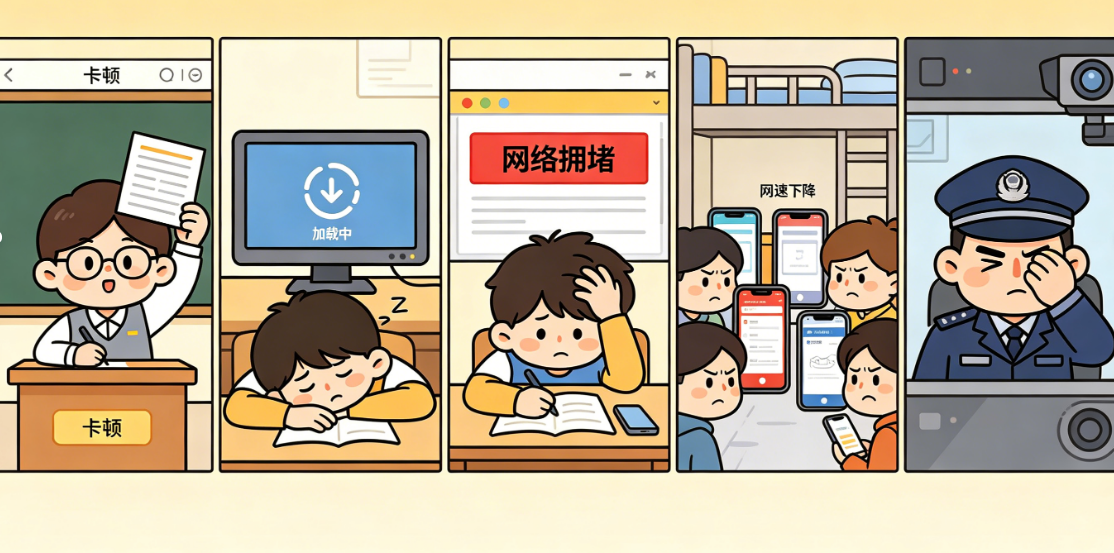
Dormitory network management has long been a headache for school logistics departments.Every night, dormitory network speed drops sharply, leading to constant student complaints.Private routers cause IP conflicts and broadcast storms.Worse still, some students stay up all night playing games and watching videos, seriously affecting rest and study.Traditional network equipment lacks precise control capabilities, leaving administrators helpless.

AINOPOL’s all-optical network solution, combined with centralized authentication and application control technologies, provides an effective solution for dormitory network management.
Differentiated Internet Access Management for Teachers & Students
Teachers and students have different Internet needs and should be assigned different bandwidth and application policies.AINOPOL achieves refined control through VLAN division and AAA authentication.
Implementation:
ONUs in teacher dormitories are assigned to the faculty VLAN.
ONUs in student dormitories are assigned to the student VLAN.
Bandwidth policies configured on the routing gateway:
Faculty VLAN: High symmetric uplink/downlink bandwidth with no application restrictions.
Student VLAN: Per-user speed limit (e.g., 20Mbps downlink, 5Mbps uplink).
During night hours (23:00 – 06:00), video applications are heavily throttled, and gaming applications are fully blocked.
Integrated Dormitory Broadcasting & Emergency Functions
Beyond Internet access, dormitories require wake-up bells, bedtime reminders, and emergency broadcasting.AINOPOL’s ONUs feature built-in audio interfaces (3.5mm or terminal block), supporting direct connection to constant-voltage speakers or IP speakers.
Via the campus broadcast platform:
Scheduled tasks: Automatic wake-up bells in the morning and bedtime reminders at night.
Emergency announcements: Dorm supervisors can broadcast to specific buildings or even individual rooms via mobile APP or office PC.
The platform also supports linkage with fire protection systems.When a fire alarm is triggered, the system automatically cuts background music, forces evacuation instructions, and unlocks access control for escape routes.A single fiber network supports Internet, broadcasting, and access control (with optional module), avoiding redundant cabling.
Late-Night Online Behavior Control
To prevent overnight gaming, AINOPOL’s application recognition library covers more than 3,000 mainstream apps, including games, short videos, and live streaming.Administrators can set time-based policies:From 23:00 to 06:00, gaming apps are blocked, and video streaming is restricted to extremely low bitrates.
The key to dormitory network management is balancing effective control and user experience.Through port isolation, VLAN division, application control, and broadcast integration, AINOPOL’s all-optical solution enables schools to implement refined management without extra O&M burdens.
FAQ
Q: Can the campus all-optical network support Internet, telephone, and surveillance simultaneously?A: Yes. A single fiber carries network, IP telephony, video surveillance, campus broadcasting, and other services without interference.
Q: Is fiber more expensive than Ethernet cable?A: Fiber itself costs less than copper cable, though splicing and installation are slightly higher.However, all-optical networks eliminate many switches, wiring closets, and power devices, resulting in lower overall deployment cost.
Q: Why should schools upgrade from traditional networks to all-optical networks?A: Smart classrooms, online exams, HD recording, VR teaching, and other applications demand increasing bandwidth.Traditional copper cables are difficult to upgrade, while an all-optical network supports decades of use after one-time deployment.
Q: Is an all-optical network suitable for kindergartens or primary schools?A: Absolutely. All-optical networks produce no electromagnetic radiation, feature simple cabling and fewer devices, making them safer and easier to maintain.They fully support interactive whiteboards, surveillance, and other teaching services.
Related Articles