


All-Optical Renovation for Smart Classrooms in Vocational Colleges: Single Fiber Enables Multi-screen Interaction & Live Recording
2026-06-05 15:42:38
10
All-Optical Renovation for Smart Classrooms in Vocational Colleges: Single Fiber Enables Multi-screen Interaction & Live Recording
Smart classrooms are gaining rapid popularity across vocational colleges, equipped with interactive large screens, split-group display panels, recording servers, electronic class boards, wireless APs and IP public address systems. Every terminal requires network access, putting mounting strain on conventional copper cabling solutions. Deploying all-optical cabling into classrooms to converge all services over one single fiber has emerged as the preferred renovation route for vocational education campuses.
Based on real-site application scenarios and AINOPOL’s optoelectronic convergence solution for K-12 & vocational education, this article illustrates how one fiber can converge full services including multi-screen interaction, recorded video backhaul, full Wi-Fi coverage, voice and public address transmission.
I. Key Pain Points in Traditional Smart Classroom Renovation
1. Bandwidth Bottlenecks Trigger Frequent Freezes During Multi-screen Interaction
Legacy 100M/Gigabit Ethernet cables have limited throughput capacity. When six to eight split-group panels cast content simultaneously during group discussions alongside multi-device wireless screen mirroring by teachers and students, video freezes and latency often exceed 300ms, making synchronous multi-screen commenting impractical. Regular 4K recording consumes high bitrates of 20~50Mbps per stream; peak-hour network congestion causes frame loss and audio-video desync, severely compromising recorded teaching resources.
2. Isolated Independent Systems Lead to Messy Cabling & Excessive Costs
Separate wiring is deployed independently for recording systems, large-screen display, campus PA, in-class surveillance and training IoT devices. Ethernet cables, power cords and audio wires crisscross ceilings and wall surfaces, resulting in stacked piles of switches inside wiring closets. Conventional cabling incurs roughly 50% higher material and labor costs per classroom versus all-optical layout, alongside drastically multiplied potential fault points.
3. Cumbersome O&M amid Shortage of Dedicated IT Engineers
The traditional three-tier network architecture (core – aggregation – access) consists of massive hardware with abundant failure-prone nodes. Training labs house diversified equipment such as industrial robots, CNC machine tools and VR headsets; network outages can take hours to troubleshoot. Many county-run and private vocational colleges have no full-time network administrators, and equipment crashes frequently force class suspension and teaching disruptions.
4. Costly, Disruptive Expansion Hinders New Curriculum Reform
Updated curriculum standards mandate new applications including virtual simulation training, AI-powered smart classrooms and standardized exam rooms, yet legacy copper infrastructure cannot smoothly upgrade to 10Gbps bandwidth. Full recabling involving wall chiseling and pipe routing damages interior decoration with prohibitive renovation costs, leaving most schools operating outdated networks under compromised conditions.
Though seemingly unrelated, these drawbacks collectively prove traditional copper networks fail to match modern smart classroom requirements. What fundamental networking criteria does a future-oriented smart classroom demand?
II. Five Core Network Requirements for Smart Classrooms

Confronted with campus intelligent upgrading demands, conventional copper-based networks fall far short of expectations: incapable of delivering sufficient high bandwidth or low-latency transmission, unable to converge diversified services and instead requiring isolated independent networks. Capacity expansion calls for destructive wall reconstruction, while daily maintenance relies heavily on tedious on-site field trips.
III. AINOPOL’s Single-fiber Solution Empowers Integrated Multi-screen Interaction & Full-scenario Classroom Recording
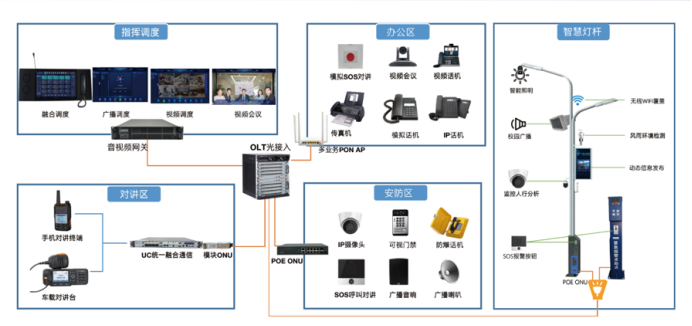
AINOPOL’s flattened PON architecture eliminates floor aggregation switches, with optical fibers routed directly from equipment rooms to optoelectronic converged ONU terminals at classroom podiums. A single fiber converges all services including multi-screen interaction, 4K lecture recording, Wi‑Fi 6 wireless access, IP public address, training room sensors and classroom access control, fundamentally resolving core networking pain points of vocational college classrooms.
1. Deployment for Multi‑screen Interaction: High‑capacity All‑optical Bandwidth Enables Synchronized Group Teaching Display
Guaranteed bandwidth: Each in‑class fiber starts with a baseline of 2.5Gbps and supports seamless future upgrade to 10G/50G. One classroom concurrently accommodates real‑time screen casting across 8 group auxiliary displays plus one main screen. Instructors can pull up all group feeds for side‑by‑side comparison with instant onscreen annotation, perfectly matching project‑based discussion pedagogy for vocational education.
Optimized wireless roaming: Wi‑Fi 6 optoelectronic integrated APs are deployed inside classrooms. Powered by the proprietary MDCA intelligent roaming algorithm, mobile handoff latency for instructors’ and students’ smartphones, tablets and training laptops stays below 50ms, ensuring uninterrupted screen casting during movement and eliminating unexpected disconnection mid‑group presentation.
Granular access control: The EAAS cloud platform supports Portal authentication via DingTalk or SMS messages. Access privileges are finely tiered: instructors are authorized for full‑screen casting while student terminals are restricted only to group display output, preventing unauthorized random screen projection in class.
2. Standardized Classroom Recording: Lossless Fiber Transmission Enables In‑class Recording & Inter‑campus Live Inspection
Local lossless 4K recording: Thanks to fiber’s low latency and immunity against electromagnetic interference, panoramic classroom cameras, instructor close‑up cameras and blackboard capture devices feed stable 4K video streams to recording hosts with synchronized audio and zero frame loss. Recordings are automatically archived to build premium course repositories for high‑quality curriculum construction and post‑class review.
Remote supervision and cross‑campus live streaming: Built on all‑optical SD‑WAN, academic affairs offices and local education bureaus remotely access classroom footage over fiber links. School principals initiate campus‑wide live broadcasts with one click, enabling off‑site observation from remote campuses and school‑enterprise cooperative institutions to share premium training resources across geographic boundaries.
Standard examination room compatibility: Existing regular classrooms are upgraded into standardized exam venues simply by adding cameras and signal jammers on top of the deployed fiber infrastructure. Recording systems connect directly to municipal and provincial education supervision platforms to fulfill monitoring requirements for independent enrollment and vocational skill certification examinations.
3. Converged Multi‑service Networking: Single Fiber Hosts PA, Training IoT and Security Surveillance
Beyond recording and multi‑screen interaction, the single fiber infrastructure supports three essential auxiliary services:
Linked IP visual public address: Lecture recording streams interconnect with classroom IP PA systems. Site‑targeted voice announcements can be triggered from the management platform once rule‑breaking classroom conduct or hidden training safety hazards are spotted, realizing a secured campus model of “visual monitoring paired with targeted voice notification”.
Closed‑loop classroom security: SOS emergency buttons and facial recognition access control link into the all‑optical network; the recording system auto‑starts upon alarm triggering, with instant alert notifications forwarded to campus security and local police stations to safeguard training classroom safety.
One Single Fiber Builds Future‑ready Smart Classroom Infrastructure
For vocational colleges, smart classroom renovation is not a one‑time fit‑out project but an evolving foundational teaching infrastructure. With the single‑fiber all‑optical solution, AINOPOL helps vocational institutions break free from the constraints of legacy copper cabling to achieve flexible all‑optical networking: smoother multi‑screen interaction, lossless video recording, full training room coverage, reduced maintenance workload and upgradeability without destructive reconstruction.
Amid the high‑quality development of vocational education, all‑optical networking delivers not only faster network speed but also improved operational efficiency, teaching quality and campus security. Leveraging optical fiber as the medium, AINOPOL keeps empowering every smart classroom.
FAQ
Q1: Can vocational colleges with no dedicated network administrators properly manage all‑optical networks?Yes. AINOPOL EAAS cloud O&M platform delivers visualized network topology, optical power monitoring, terminal status inquiry and remote device reboot via graphical interfaces with no CLI commands required. The system automatically generates fault alerts and pinpoints problematic classrooms for common issues such as offline ONUs, which can be resolved by regular campus IT staff. Passive optical splitters installed in wiring closets drastically cut on‑site maintenance visits.
Q2: How does the upfront cost of all‑optical compare with traditional copper cabling?Initial hardware cost for OLT and ONU is marginally higher than conventional switches, yet expenditure on multiple floor switches, bulk Ethernet cables, power cords and trunking plus related installation labor is eliminated, leading to equal or lower overall cabling outlay. More importantly, total cost of ownership (TCO) covering power consumption, maintenance and future upgrades drops by over 50% across the equipment lifecycle for remarkable long‑term savings.
Q3: Can all‑optical infrastructure share the same fiber with campus PA, surveillance and telephone services?Absolutely. Dedicated VLANs configured on a single OLT logically isolate smart classroom networking, dorm internet access, security surveillance, IP PA and analog telephone services to implement full‑campus coverage over one unified fiber network. AINOPOL ONUs come with built‑in RJ11 ports for direct analog telephone access.
Related Articles


