


How Can Full-Optical Networks Eliminate Security Blind Spots of Dumb Terminals?
2026-08-14 15:20:31
18
How Can Full-Optical Networks Eliminate Security Blind Spots of Dumb Terminals?
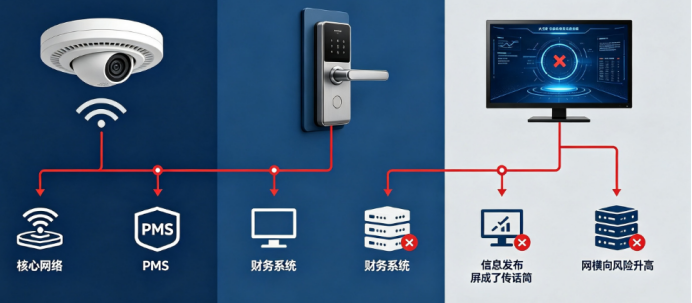
Practical Implementation of Unified Access Control for Cameras, Access Control Systems and PLCs
Walk into any enterprise park, and you will see ceiling-mounted surveillance cameras, facial recognition access control terminals at entrances, buzzing PLC controllers on production lines, and information display screens in corridors. These devices run quietly around the clock, yet few people realize they may be operating with zero cybersecurity protection.
Surveillance cameras cannot install antivirus software, access control panels have no interface for password input, and PLCs do not even come with display screens. In traditional cybersecurity frameworks, such devices are collectively referred to as dumb terminals. They are “dumb” because they cannot send alert signals, complete identity authentication or implement self-protection, making them the most vulnerable entry points favored by cyber attackers.
Hackers do not need to breach your firewall. They only need to find a camera still using the factory default password.
I. Dumb Terminals: The Most Overlooked Backdoors in Corporate Networks
Scenario 1: Cameras Turn Into Internal Breach Points
A company once suffered a shocking security incident: lawbreakers disguised miniature spy cameras as smoke detectors, gained access to the conference room, streamed covert footage and sold the recordings on the dark web for profit. Subsequent investigations revealed the root cause: the enterprise Wi-Fi lacked any device-level access control, allowing any MAC address to connect and obtain an IP address. In short, anyone could plug an unauthorized device into the network without the company’s knowledge.
Scenario 2: Access Control Systems Act as Attack Jump Hosts
Corporate networks are flooded with massive IoT smart devices, including smart speakers, set-top boxes and intelligent door locks. Most of these devices suffer from delayed firmware updates, unchanged default passwords and long-term missing security patches. Attackers can exploit firmware vulnerabilities and unauthorized access interfaces to inject malicious code. Once they compromise a single IoT device, they can use it as a springboard to penetrate the core network and launch lateral attacks on high-value systems such as PMS and financial databases.
Scenario 3: Digital Signage Becomes a Reconnaissance Relay
After the information display screen in a technology park was hacked, attackers tampered with on-screen content and leveraged the device to perform lateral scanning across the internal network. A screen designed solely for posting notifications was transformed into a backdoor for hackers to spy on the LAN.
Why Are Dumb Terminals So Easy to Compromise?
The fundamental reason is that traditional cybersecurity models are powerless against dumb terminals.
Dumb terminals cannot install authentication clients, enter usernames and passwords, or execute security policies. Under legacy architectures, network access authentication operates separately from business systems, leaving cameras, access controllers, PLCs and similar devices in permanent identity blind zones. Unrestricted MAC address access permits unknown devices to infiltrate the internal network freely.
More alarmingly, attacks targeting building automation equipment have exploded since 2026. Starting in March, the U.S. Cybersecurity and Infrastructure Security Agency (CISA) consecutively disclosed critical vulnerabilities in products from multiple building automation manufacturers. Zero-day flaws such as CVE-2026-3611 (CVSS score: 10.0) enable attackers to take full control of building management devices without any login credentials. Hotels, industrial parks and factories are core deployment scenarios for building automation systems, and a successful breach would lead to catastrophic consequences.
Do you think installing a few surveillance cameras guarantees safety? Hackers may be watching your premises right through those lenses.
II. Why Traditional Security Solutions Fail to Protect Dumb Terminals
The legacy model of bolting on disjointed security appliances has three fatal flaws when defending dumb terminals:
Flaw 1: No Access Control — Open Access for All
Conventional networks grant indiscriminate access to all connecting devices. Any MAC address can join the network and acquire an IP address. Since dumb terminals like cameras, access panels and PLCs cannot install client software or accept manual password entry, they remain perpetual security blind spots.
Flaw 2: No Isolation — Unrestricted Lateral Movement
Once a dumb terminal is compromised, attackers can pivot freely across the internal network. The takeover of one single camera may result in the full compromise of the entire local area network.
Flaw 3: No Audit Trails — Untraceable Malicious Activity
Online behaviors of dumb terminals are neither logged nor audited. If a hacked camera is abused to launch DDoS attacks, the enterprise cannot identify which device initiated the attack or the exact timestamp.
Decree No. 151 of the Ministry of Public Security mandates retaining internet behavior logs for a minimum of 180 days, with data required to be tamper-proof, exportable and auditable. Traditional architectures cannot generate complete audit logs for dumb terminals at all.
The newly revised Cybersecurity Law has raised the maximum corporate penalty from hundreds of thousands to 10 million RMB, with individual liable personnel facing fines up to 1 million RMB. Unaddressed dumb terminal security loopholes now directly translate to substantial regulatory fines.
III. How Full-Optical Networks Eliminate Dumb Terminal Security Blind Spots
Tailored for real-world enterprise park scenarios, AINOPOL builds a new-generation campus communication framework featuring unified full-optical network bearing, deep audio-video convergence and native embedded security protection. The core design philosophy is integrated transmission and encryption: security capabilities are embedded into the network architecture by default, rather than added as external aftermarket components.
The full-optical network closes dumb terminal vulnerabilities through three layered mechanisms:
Layer 1: Port-Level Mandatory Access Control — Authenticate First, Grant Access Later
Unlike legacy networks that allow unvetted connections, the full-optical system enforces rigid binding between ONU physical ports and device MAC addresses. Every terminal undergoes identity verification the moment it plugs into the network. The exact ONU port for each camera and the bound hardware for each access control unit are pre-registered with one-to-one mapping. Unauthorized devices trigger instant automatic blocking and system alerts upon connection attempts.
The real-name access framework in the AINOPOL solution makes every connection of each dumb terminal traceable to the specific hardware and physical deployment location. Even if an attacker gains physical access to the network cable of a camera, the packet will be discarded entirely if its MAC address is not on the whitelist.
Layer 2: Logical Business Domain Isolation — Contain Breaches Within Boundaries
Conventional VLAN isolation can be bypassed with relative ease. AINOPOL’s full-optical network adopts protocol-layer logical isolation based on PON architecture, partitioning the network into mutually isolated business domains at the bottom of the protocol stack: the security domain for cameras and access controllers, and the publishing domain for digital signage. Inter-domain communication is blocked by default. Even if hackers seize control of an information display screen, they cannot cross isolation barriers to intrude into the core LAN. A compromised dumb terminal can no longer escalate into a company-wide network disaster.
Layer 3: End-to-End Full Audit — Record All Network Activities
Log collection, correlation and archiving are natively integrated into the centralized management platform of the AINOPOL full-optical network. The system automatically records connection timestamps, access trajectories and traffic statistics of every dumb terminal with complete data fields, including MAC address, IP address, authentication credentials, timestamp and destination access targets.
Logs are stored locally for no less than 180 days and support one-click export of compliance reports formatted for regulatory inspections. Security incidents can be fully traced with clear evidence chains, eliminating dead ends in post-breach investigations.
The three mechanisms work in tandem: access control secures the entry perimeter, isolation blocks lateral attacker movement, and auditing preserves comprehensive forensic records. Dumb terminals are transformed from hidden security gaps into fully transparent, monitored endpoints.
IV. Step-by-Step Deployment Guide for Unified Dumb Terminal Access on Full-Optical Networks
Step 1: Inventory and Register All Dumb Terminals
Conduct a full stocktake of all dumb terminals across the park, including surveillance cameras, access control panels, PLCs, digital signage and IP speakers. Document the MAC address, installation location and affiliated business domain for each device. If you cannot quantify how many cameras and access systems you have deployed on-site, your organization becomes a prime target for cybercriminals.
Step 2: Bind Ports and Partition Business Domains
Within the full-optical network management platform, bind the MAC address of each dumb terminal to its fixed ONU port. Meanwhile, divide the network into independent business domains (security domain, office domain, publishing domain) to enforce inherent isolation between different service clusters.
Step 3: Push Down Security Policies and Enable Continuous Monitoring
Deploy access whitelist rules and audit configurations in bulk via the unified cloud management platform. Every device is authenticated on access, and all traffic is logged in real time. The platform continuously monitors the operational status of dumb terminals and sends automatic alerts for abnormal behaviors.
Do not wait for a security breach to retrofit safeguards — by the time you patch vulnerabilities, core business operations may already be paralyzed.
Traditional networks rely on fragmented external security hardware to patch defenses, which only delivers superficial protection for massive numbers of unprotected IoT dumb terminals. Three persistent flaws — unregulated entry points, zero internal segmentation and non-existent post-incident tracing — constantly expose enterprises to data leaks, LAN intrusions and crippling regulatory penalties.
For enterprises, industrial parks and hospitality venues, a full-optical infrastructure with native embedded security is far more than a bandwidth-upgrade utility. It serves as the core defensive bulwark to lock down IoT dumb terminal attack surfaces and avoid maximum 10-million-yuan fines under cybersecurity regulations.
FAQ
Q: What exactly are dumb terminals, and why are they named as such?
A: Dumb terminals refer to network devices unable to install security client software, accept interactive username/password input, or support manual operation via display panels. Typical examples include IP surveillance cameras, access control controllers, PLC programmable logic controllers, digital information screens and IP speakers. They are called “dumb” because they cannot generate warning alerts or execute self-defense protocols, yet they are the most preferred attack vectors for hackers.
Q: What is the worst possible outcome following a dumb terminal compromise?
A: Dumb terminals are rarely the ultimate target of intruders — they are used as attack pivot points. After hijacking a camera, attackers can move laterally inside the LAN to infiltrate OA systems, ERP platforms and financial databases. Critical vulnerabilities such as CVE-2026-3611 (CVSS score 10.0) in 2026 prove that adversaries can fully take over building automation hardware without any login credentials. A single breached access control device could lead to the complete exfiltration of an enterprise’s most sensitive core data.
Related Articles


