


Risk of Interception When Transmitting Branch Surveillance Footage Back to Headquarters? How All‑Optical SD‑WAN with National Cryptography Encrypted Tunnels Prevents Data Exposure
2026-08-22 14:33:02
15
Risk of Interception When Transmitting Branch Surveillance Footage Back to Headquarters? How All‑Optical SD‑WAN with National Cryptography Encrypted Tunnels Prevents Data Exposure
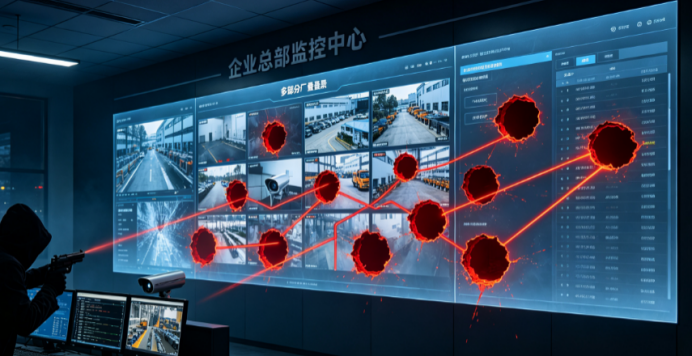
With multiple branch sites and dozens or even hundreds of cameras, how do headquarters traditionally view surveillance footage centrally?
Enterprises typically map the ports of each branch’s NVR to the public internet.
This practice is equivalent to drilling dozens of holes in the corporate security perimeter. A hotel manager needed remote surveillance access during a business trip, so the IT department set up port mapping for him. Three months later, hackers brute‑forced the password via this public port and gained full access to live feeds and recorded footage from all cameras. To make viewing convenient for one user, the entire world was granted visibility into the surveillance system.
When branch surveillance video travels across the internet to headquarters, the data is transmitted unprotected, or “in plain sight”.
I. Three Critical Flaws in Traditional Surveillance Backhaul Solutions
Port mapping: leaving the door wide open
Many businesses configure port forwarding on routers to expose the access ports of branch NVRs to the public internet. Attackers can easily locate these exposed devices using search engines such as Shodan. Once an NVR is directly published online, anyone can attempt a connection.
A more hidden risk is that many surveillance devices enable UPnP by default. They automatically open router ports without administrator awareness, leaving services unintentionally exposed to the public network.
Weak passwords become easy targets for hackers
A large number of surveillance devices retain factory passwords throughout their service lifecycle. Credentials such as “admin/123456” are the default for hundreds of millions of cameras globally. Attackers can perform brute‑force attacks at minimal cost; default passwords are even listed in official product manuals.
Conventional VPN: one login grants unrestricted access
Some companies recognise the risks of port mapping and deploy VPNs for management staff. However, traditional VPNs offer coarse‑grained authorisation. A single login grants full network access with no granular controls. A user authorised to view Camera A can also access Cameras B, C and D. Compromise of one VPN appliance exposes cameras across an entire building or branch to threat actors.
II. How All‑Optical SD‑WAN Secures Surveillance Video Transmission
AINOPOL’s integrated SD‑WAN + CVR solution fundamentally transforms how surveillance footage is relayed. Instead of punching holes into the public internet, it creates encrypted virtual private tunnels over the internet.
No public exposure, no port forwarding — attackers cannot find the entry point
AINOPOL SD‑WAN supports networking without public IP addresses. Devices achieve zero‑configuration automatic networking upon power‑up, establishing national cryptography encrypted tunnels to connect headquarters and branch intranets. No port mapping is required, NVRs remain isolated from the public internet, and attackers cannot scan or discover these targets.
National cryptography encrypted tunnels: data travels inside a secure vault
Video streams captured by branch cameras are transmitted back to headquarters through SD‑WAN encrypted tunnels with end‑to‑end data protection. Dual encryption is implemented: hardware encryption over the in‑branch PON optical link, plus SD‑WAN tunnel encryption between branches and headquarters. This ensures surveillance footage is never transmitted in plaintext.
Zero Trust access plus two‑factor authentication: precise visibility control per user
Unlike traditional VPNs that grant full access after login, the AINOPOL solution adopts a Zero Trust access model. Remote maintenance and video viewing must pass through the encrypted SD‑WAN tunnel, supplemented by two‑factor authentication such as dynamic tokens or biometric verification. Permissions are defined precisely by user, accessible camera list and valid access duration, rather than allowing full access after a single sign‑on.
Isolated dedicated security network: separate paths for surveillance and office traffic
The AINOPOL deployment uses an independent security VLAN strictly segregated from office and production networks, prohibiting unauthorised public port mapping. Device admission control enforces password complexity rules; devices using weak or default passwords are automatically blocked. Even if a camera is compromised, attackers cannot move laterally to office or production networks.
Traditional remote surveillance backhaul relies on port mapping and loosely defined VPN permissions, creating persistent high‑risk vulnerabilities including public exposure, brute‑force attacks on weak passwords, and excessive privilege escalation. These security gaps make security cameras an easily overlooked breach vector. The AINOPOL integrated SD‑WAN + CVR solution replaces public port exposure with encrypted tunnels, combined with Zero Trust granular permissions and dedicated network isolation. It thoroughly addresses plaintext data transmission, device exposure and unauthorised access, enabling secure transmission, controllable access and full lifecycle protection for surveillance video to safeguard the enterprise dedicated security network.
FAQ
Q: What is the most common risk when sending branch surveillance footage to headquarters?
A: Port mapping is the primary risk. For convenient remote viewing, administrators map NVR ports to the public internet on routers, which creates an opening in the security perimeter. Attackers locate these exposed devices via tools such as Shodan, brute‑force credentials and obtain all surveillance feeds.
Q: Can surveillance video be intercepted while travelling over the internet?
A: Under traditional port‑mapping setups, data is transmitted in plaintext and vulnerable to interception and theft. AINOPOL SD‑WAN uses national cryptography encrypted tunnels with end‑to‑end protection. Captured packets cannot be decrypted even if intercepted.
Q: Can SD‑WAN be deployed at branches without public IP addresses?
A: Yes. AINOPOL SD‑WAN supports networking without public IP addresses. Devices complete zero‑configuration automatic networking once powered on. No fixed public IP application or port mapping is needed; standard business broadband works perfectly.
Related Articles


