


New product in the integrated communication industry, 'Optoelectronic Composite Cable': simplifies long-distance energy and data transmission, and increases bandwidth by N+1 times!
2025-09-29 14:07:21
422
Background of the emergence of optoelectronic composite cables
As is well known, cables are used to transmit data and can only handle network services through access devices. It can be seen that in order to ensure the normal operation of network services, cables and equipment are necessary.
In the field of communication, cables can be divided into optical cables with optical fibers as the transmission medium and copper cables with copper wires as the transmission medium according to different media.
Fiber optic cables use the principle of total reflection of light for data transmission, which has the advantages of large bandwidth, low loss, and long transmission distance. However, fiber optic cables are composed of glass fibers and are electrical insulators, which cannot support POE power supply.

Copper wire uses metal as the transmission medium and utilizes the principle of electromagnetic waves for data transmission. It can transmit both data signals and power signals. However, there may be thermal effects during the transmission process, resulting in significant losses and unsuitable for long-distance data transmission. Additionally, according to the network cabling standards, the total length of twisted pair links cannot exceed 100 meters.
After understanding the cables, we went back to the devices mentioned earlier. The structural form of the equipment should be adapted to the local environment in order to ensure power supply. However, in reality, some devices have relatively complex installation environments, such as WLAN APs, 5G small base stations, video surveillance cameras, etc., making it difficult to find suitable power sockets during device installation.
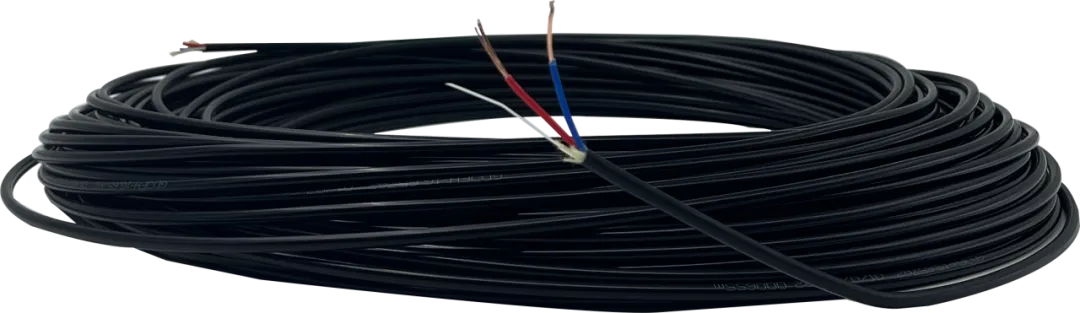
With the continuous development of technology, the demand for network transmission speed is becoming increasingly urgent. However, traditional copper wires have become inadequate in expanding their long-term bandwidth evolution. In addition, although fiber optic provides the ability for high-speed transmission, it cannot solve the problem of POE power supply, and also faces the challenge of adapting to equipment structure and site environment.
All of these issues require an innovative cable solution in the market that can meet the growing demand for network transmission and adapt to various scenarios. In response to this demand, optoelectronic composite cables have emerged.
Intelligent Optics presents the excellence of ZH-GX1255 optoelectronic composite cable
As a well-known enterprise in the field of communication, Smart Photonics has its own research and development team, has won multiple patents, and passed ISO9001 certification in 2020 and was awarded the title of "National High tech Enterprise". With its independently developed intelligent software and hardware equipment, it has won the love of industry personnel. Its latest product is a model ZH-GX1255.
-Cross section of optoelectronic composite cable-

This is a 1-core single-mode fiber optic composite cable that fully utilizes the advantages of copper wire and optical fiber, solving the problems of data transmission and equipment power supply. To help everyone understand how it avoids the limitations of copper wire and fiber optic in communication transmission, and simultaneously solves the challenges of data transmission and equipment power supply. Next, the editor will provide a detailed introduction to the optoelectronic composite cable of Smart Optics.
01. Structure
This 1-core single-mode fiber optic composite cable is mainly used indoors. It has a flat shape and consists of two main parts: a cable core with a layer twisted structure and a protective layer. Among them, one fiber core and two copper wires are combined and play different roles. One fiber core is only responsible for the transmission of data signals, while the two copper wires are only responsible for the transmission of power signals. The protective layer includes a sheath and an outer protective layer, and its main function is to ensure that optical signals and electrical signals do not interfere with each other during transmission.
02. Application Fields
This comprehensive cabling is mainly used for connecting switches with APs or remote modules in various network systems in the "six major scenarios" of intelligent optocommunication. One end is connected to the optoelectronic hybrid interface of the CS8505E switch, and the other end is connected to the optoelectronic hybrid interface of the three RF indoor deployment type AP or remote module. As shown in the following figure:
03. Advantages
Small outer diameter, light weight, and small space occupation. (A series of problems that can usually be solved by multiple cables can be replaced with one cable.)
Has superior bending performance and good flexibility.
On site completion, easy deployment, and no need for engineering survey.
Provide data transmission and remote power supply functions for devices.
To solve the problems of broadband access, equipment power consumption, and signal transmission,
Effectively reducing construction and network construction costs, achieving the goal of multiple uses on the front line.
04. Reference standards
The relevant performance of this product meets the communication industry standards YD/T901-2001 communication layer twisted optical cable, YD/T1258.2-2003 indoor optical cable series Part 2: Single core optical cable; The cable transmission part meets the requirements of GB5023-2008 "Polyvinyl chloride insulated cables with rated voltage of 450/750V and below"
05. Product Recommendations
We warmly recommend our upcoming combination product "Optical FTTN Optical AP".
Related Articles


