


How can all-optical networks reshape the competitiveness of hotels?
2026-01-05 14:16:06
172
How can all-optical networks reshape the competitiveness of hotels?
Behind the TV and under the bedside table in hotel rooms, there often lurks a chaotic "cable jungle" - with network cables, telephone cables, and TV cables all running their own courses. This not only drives up construction costs but also poses ongoing operational and maintenance challenges.
When you are still struggling with issues such as slow Wi-Fi in guest rooms, complex TV wiring, and outdated telephone lines, have you ever thought that the root of these problems may all point to the same place - the outdated integrated wiring architecture.
Traditional copper cable networks (Category 6 cables, coaxial cables) are becoming a heavy burden for hotels. Addressing this core pain point in the broader accommodation industry, AINOPOL has innovatively launched an optical-electrical converged communication solution based on an all-optical network architecture - enabling all services such as Wi-Fi, wired networks, TV, telephones, and room control to be carried and transmitted through a single fiber.
Why has traditional networking become a "heavy burden" for hotels?
Upon entering any hotel room, one finds televisions, telephones, Wi-Fi, and guest controls... Behind these seemingly ordinary services often lurk intricate cables and devices. This "stove-pipe" approach poses a triple challenge to the hotel industry.
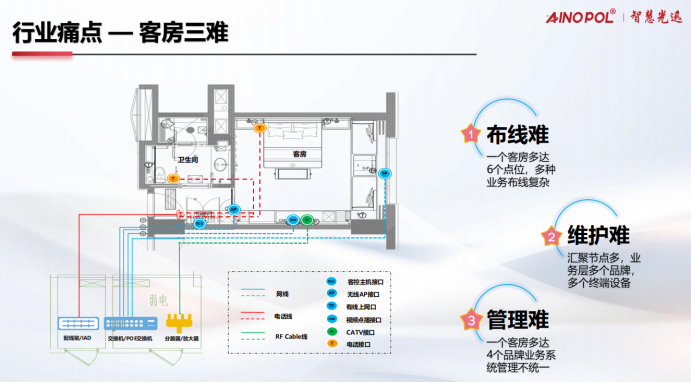
High and increasing costs: In traditional cabling, multiple independent cables need to be deployed for services such as TV, telephone, internet, and guest control in a single guest room, often resulting in up to six or more cabling points.
According to industry data estimates, the cost of wiring materials and labor alone may exceed 500 yuan per guest room. For a hotel with 100 guest rooms, this initial investment amounts to over 57,000 yuan.
Operation and maintenance are complex and inefficient: systems from different brands operate independently, making fault localization difficult. When customers report network issues, engineers may need to troubleshoot multiple links such as switches, routers, and APs one by one, which can take hours.
With multiple business systems coexisting, maintenance personnel are required to master the management interfaces of different devices, which incurs high training costs and is prone to errors.
Significant energy consumption and difficult upgrades: Standalone devices and switches continuously consume power, while old copper cables have a limited lifespan and usually need to be replaced after about 10 years. Each new service may require rewiring.
What is even more challenging is that when hotels wish to introduce new applications such as intelligent guest control, high-definition video-on-demand, and AI voice services, traditional network architecture often becomes a bottleneck.
The Subtraction Revolution: How AINOPOL Realizes "One Fiber, Multiple Networks"?

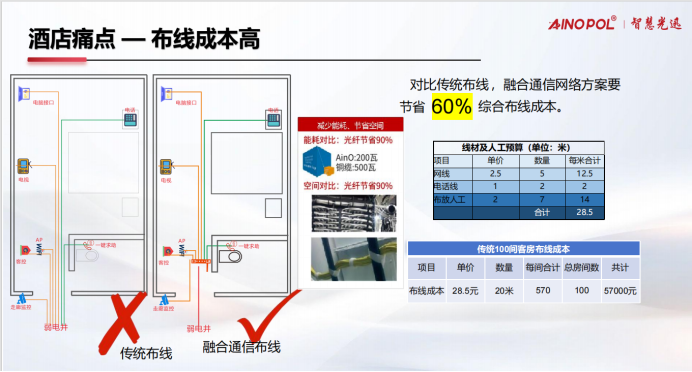
Facing these challenges, AINOPOL's all-optical network integration solution performs "subtraction" at the source, with the core being to integrate all services into a single thin optical fiber.
In traditional solutions, services such as TV, telephone, internet, and guest control in guest rooms are independently wired. AINOPOL's all-fiber solution uses microfiber cables to directly connect to each room, replacing all traditional copper cables. This change brings multiple benefits.
From a cost perspective, the cost of integrated cabling can be reduced by over 60%. Apart from the materials themselves, the difficulty and duration of construction are also significantly reduced. More importantly, the lifespan of optical fiber can reach up to 30 years, far exceeding that of traditional copper cables, thus fundamentally avoiding the trouble of repeated construction.
From the perspective of energy consumption, optical fiber transmission boasts extremely low power consumption, and the integration of equipment has reduced a significant number of active switches, leading to a reduction of approximately 90% in the overall network energy consumption space. This directly assists hotels in achieving their ESG energy-saving goals.
Additive Value: How can a network transform from a cost center into a value platform?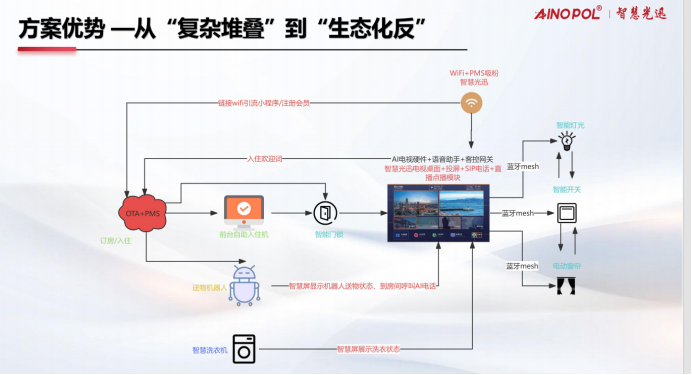
Beyond mere subtraction, the AINOPOL solution also upgrades the network into an intelligent hub for hotel operations and services through "addition".
1. Seamless experience: breaking the "network island"
Seamless roaming ensures that guests' Wi-Fi connection is never interrupted as they move freely around the hotel. From the lobby to the rooms, and from the restaurant to the conference rooms, the network connection switches seamlessly, providing a consistent and smooth experience.
For hotel chains, this technology enables cross-hotel roaming, allowing members to move between hotels of the same brand in different cities without having to authenticate repeatedly, greatly enhancing the sense of belonging and convenience for high-end customers.
2. Smart Screen Display: TV Becomes a New Service Entry Point
The hotel TV is no longer just a device for watching programs, but has become a smart terminal integrating various services. The private screen mirroring feature ensures security through a random password, allowing guests to easily project their phone content onto the large screen.
Even more intelligently, the TV can display in real time the arrival time of the delivery robot, the idle status of the AINOPOL washing machine, and even connect to the public area cameras to view the flow of people in the pool and gym.
3. Marketing Conversion: Wi-Fi Becomes a Powerful Tool for Traffic Attraction
Traditional hotel Wi-Fi is merely an infrastructure, but AINOPOL transforms it into a member marketing platform. When guests connect to Wi-Fi, a customized Portal authentication page can display the hotel's latest events and promotional information, and provide a one-click jump to a mini-program for completing member registration or service booking.
The system seamlessly integrates with the hotel's PMS, enabling it to recognize member levels and provide differentiated internet experiences. This transformation has turned an original cost item into a revenue growth point.
Green Future: Why is All-Optical Network a Strategic Investment for Hotels?
The value of the all-optical network solution lies not only in solving current problems, but also in laying a green path for hotels that is oriented towards the future:
The main material of optical fiber is glass fiber, which is corrosion-resistant and has a service life of up to 30 years. This means that one investment can cover multiple renovation cycles of hotels, avoiding the trouble and cost of replacing copper cables every 10 years or so. From the perspective of sustainable development, this significantly reduces the generation of electronic waste.
Smooth evolution is another major advantage of all-optical networks. The currently deployed GPON networks can be easily upgraded to 10G PON or even higher speeds. The existing all-optical network cabling can meet new business needs such as 8K video, cloud gaming, and VR experiences without any modifications in the next 5-10 years.
The all-optical network represents not only a technological upgrade but also a strategic choice for hotels to transition from "passive operation and maintenance" to "active service" and from a "cost center" to a "value platform". With its converged architecture of "one fiber, multiple networks", it brings a comprehensive reshaping of competitiveness in cost, experience, operation, and future evolution to hotels.
Related Articles


