


How can chain hotels achieve seamless member roaming across different stores?
2026-01-07 14:29:14
149
How can chain hotels achieve seamless member roaming across different stores?
For hotel chains, the real service challenge often lies not in the experience within a single hotel, but in the gap in cross-hotel experiences. When a guest connects to WiFi at a Beijing branch and checks into a Shanghai branch a week later, do they have to authenticate again? When a group has dozens or even hundreds of hotels under its umbrella, can WiFi experience become a bond of brand loyalty, rather than the starting point of a broken experience?
This seemingly minor detail is becoming a crucial yardstick for measuring whether a hotel chain brand has truly achieved an "integrated experience". Every interruption and repeated authentication of network connection silently undermines the unified image that the brand strives to portray.
When the experience is "disconnected" across stores: how does cross-store network authentication become a stumbling block to brand unification?
So can the service experience be seamlessly continued across different stores? WiFi authentication is the first digital touchpoint that guests must encounter upon arrival. If there is a gap here, it will directly lead to a triple problem:
Experience of disconnection: Guests instantly transition from being "recognized members" to "strangers requiring re-verification," leading to a sharp drop in brand warmth.
Efficiency loss: Frequent authentication operations disrupt business trips, wear down guests' patience, and easily breed negative emotions.
Trust loss: The unpredictability of online experiences indirectly calls into question the brand's commitment to consistency across other service standards.
This is not only an inconvenience in operation, but also indicates that the hotel has failed to successfully extend the continuity of offline services to the digital space.
AINOPOL solution: From "repeated authentication" to "one-time authentication, access across the entire network"
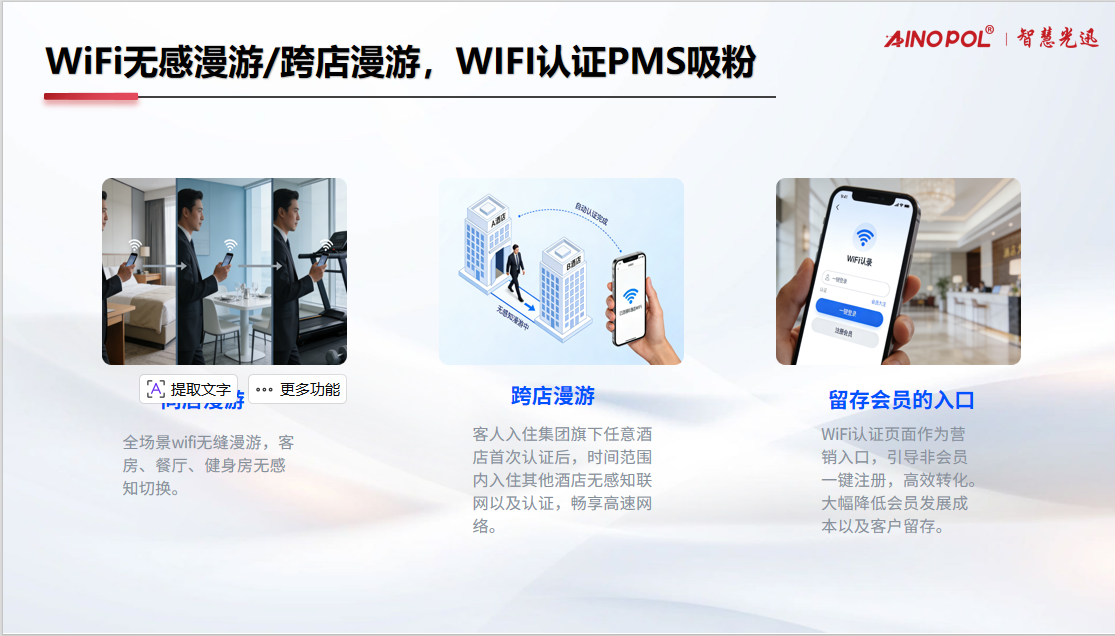
AINOPOL's solution directly addresses the core of this contradiction - by enabling "seamless roaming across stores", it transforms guests' network access permissions into a "digital passport" that allows them to freely navigate within the brand's entire domain.
The key to achieving this experience lies in the group-level unified management of "identity" and "network".
We establish a unified identity authentication hub by securely docking with the hotel group's PMS (Property Management System/Central Member Database). After a guest completes WiFi authentication for the first time at any of the hotels under the group, their authorization token or anonymized identifier can be securely synchronized on the group's cloud. When the same guest checks into another hotel within the group, network authorization is automatically completed through terminal recognition or backend identity matching, enabling seamless, zero-operation cross-hotel access.
This brings about a significant enhancement of triple value:
To guests: This achieves a seamless experience of "connectivity upon check-in". For example, a business guest who frequently travels in East China and needs to travel between different hotels under the group in different cities no longer needs to search for passwords or undergo repeated authentication at each hotel. From check-in to check-out, and even on the way to the next hotel, high-speed internet is always online and seamlessly connected. This high level of convenience and respect directly translates into deep recognition of "this brand understands me" and "choosing them is always smooth", greatly enhancing brand preference and willingness to return.
For hotels: The network has evolved from a "cost burden" to an "efficiency tool and revenue-generating touchpoint". Front-desk staff no longer need to frequently handle guests' online connection inquiries or authentication failures, freeing up manpower. More importantly, a stable network itself ensures the guest room experience, directly reducing the complaints that arise from it. At the same time, the authentication page can be flexibly configured, becoming a precise channel for pushing local dining discounts, SPA experiences, or membership upgrade activities to already checked-in guests, creating new revenue opportunities.
For the group: This establishes a unified "digital service standard" and core data assets. The group headquarters can centrally manage the network policies, security standards, and access experience of all branches, ensuring consistency in brand services. More importantly, through this unified network, the group can anonymously gain insights into customers' cross-store mobility preferences and connection behaviors in a compliant manner, providing valuable data decision support for overall member marketing, new store layout, and even service innovation, thereby establishing an unimitable digital moat in market competition.
The true value of an intelligent network should not be confined within the walls of a single hotel. For chain brands, it should serve as a digital thread that connects across all domains, delivers a unified brand promise, and deeply binds guest loyalty.
What we offer is not just a set of network equipment, but also an operational mindset centered around "a coherent user experience". We assist hotel chains in ensuring that guest recognition and trust transcend every branch, always being online.
Related Articles


