


Multi-terminal calling, a smart network solution that reduces costs and increases efficiency by 45% for hotels
2026-01-12 15:19:08
170
Multi-terminal calling, a smart network solution that reduces costs and increases efficiency by 45% for hotels
In the hotel industry, the front desk has always been the core hub of service circulation, but it often becomes a bottleneck of efficiency - repetitive inquiries, long waits during peak periods, insufficient staff for night services... These issues not only affect the guest experience but also leave front desk staff exhausted.
Nowadays, with the integration of AI technology and multi-terminal hardware, a smart service model that "does not replace human labor but liberates it" is quietly reshaping the hotel operation landscape.
The pain of the front desk: repeated inquiries consume energy, and maintaining service warmth is challenging
Many hotel front desks have to deal with a large number of similar issues every day:
"What is the Wi-Fi password? ”
"What time does breakfast start?"
"How do I adjust the air conditioning in the room?"
According to statistics, such repetitive inquiries can account for 40%-50% of the daily work at the front desk, especially during peak check-in/check-out periods. Front desk staff are constrained by basic questions and answers, making it difficult for them to provide more personalized and warm services. When there are limited staff on duty at night, delayed responses directly affect the guest experience.
The key to breaking the deadlock: AI+ multi-terminal, making services accessible anytime, anywhere
AINOPOL's multi-terminal call and AI collaboration solution is not about replacing human labor; rather, it leverages technology to delegate repetitive and standardized tasks to AI, allowing employees to return to their role as "service providers". The system supports one-click/voice direct connection from various terminals in guest rooms to the front desk, establishing a three-dimensional and real-time service network:
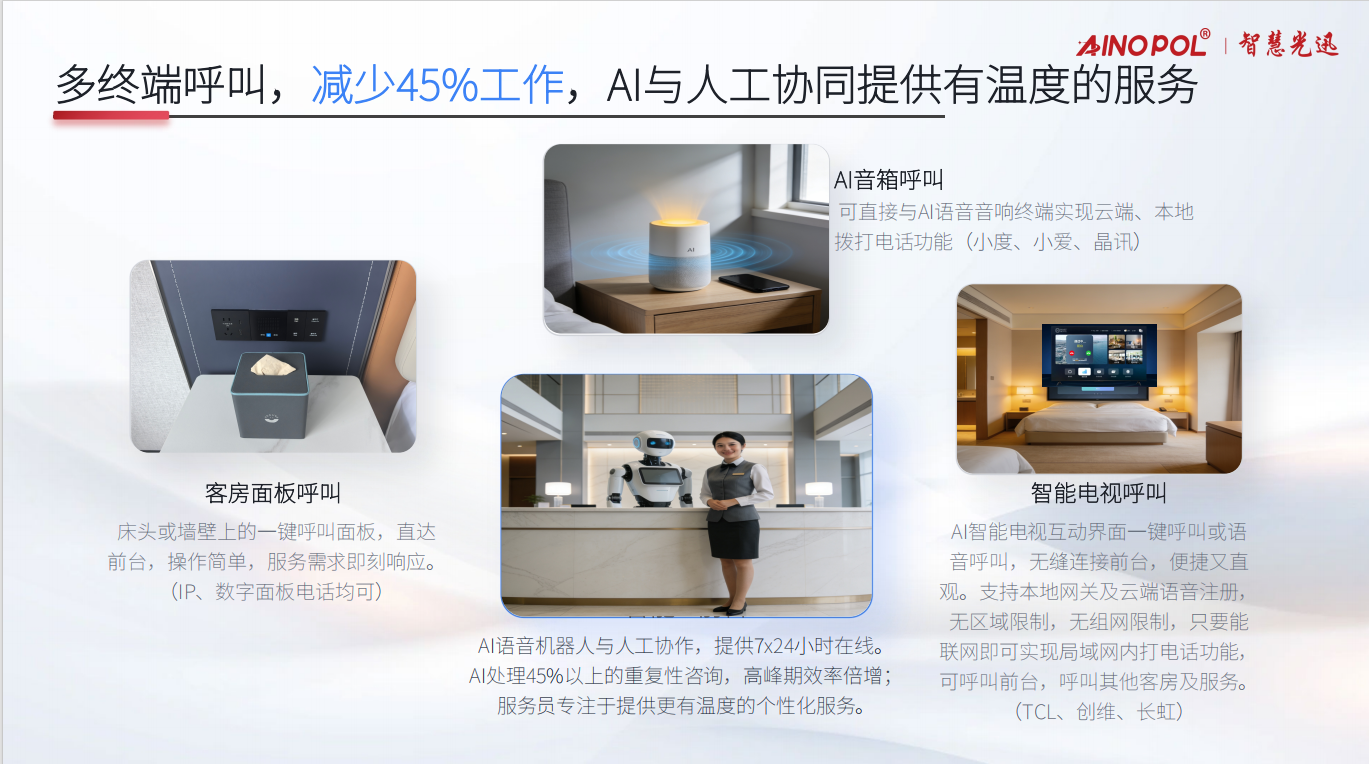
Guest room panel call: Install a one-button call panel (supporting IP and digital phones) at the bedside or on the wall, so guests can press it to connect to the front desk without having to search for a phone number. This is especially suitable for elderly guests or users who are not accustomed to smart devices, as the operation is intuitive and the response is zero-delay.
AI Speaker Voice Call: Integrated with mainstream smart speakers such as Xiaodu, Xiaoai, and Jingxun, guests can simply issue commands like "Call the front desk" or "I need mineral water" to directly access the hotel system. The voice interaction is natural and more tailored to the usage habits of younger guests and families traveling together.
Smart TV Call Integration: Embedded with a customized interface in TVs from brands such as TCL, Skyworth, and Changhong, guests can make a call with a single button on the remote control or directly voice their requests. The system supports cloud and local gateway deployments, with no geographical or networking restrictions. As long as it is connected to the internet, it can achieve interconnectivity between guest rooms, front desks, and other service points.
Whether guests are in bed, on the sofa, or in the bathroom, they can initiate a call through the nearest terminal, ensuring that service responses are invisible yet omnipresent. AI voice robots automatically respond to common inquiries, handling over 45% of standardized questions and supporting 24/7 online availability. During peak check-in periods, the front desk is no longer interrupted by requests such as "directions" or "password requests", allowing staff to focus on processing formalities and answering complex questions, thereby enhancing the warmth of service.
In today's hotel industry, where competition is increasingly focused on "experience details", AINOPOL starts by reducing repetitive labor. Through the seamless integration of AI and terminals, it not only reduces the workload of the front desk by 45%, but also reconstructs the logic of service resource allocation - letting machines do what they are good at and humans do what they should do. The ultimate achievement is a next-generation hotel service experience that combines efficiency and warmth.
Related Articles


